TIBSOVO in R/R MDS
What is the TIBSOVO (ivosidenib tablets) indication in R/R myelodysplastic syndromes (MDS)?
TIBSOVO is the first and only FDA-approved targeted treatment for MDS. TIBSOVO is indicated for adult
patients with R/R mIDH1 MDS. TIBSOVO can be used to treat lower-risk and higher-risk MDS. The TIBSOVO
label does not include limitations based on types or number of prior lines of therapy, meaning TIBSOVO
can be used broadly in the R/R MDS with mIDH1 treatment space.1
Which patients may be appropriate for TIBSOVO?
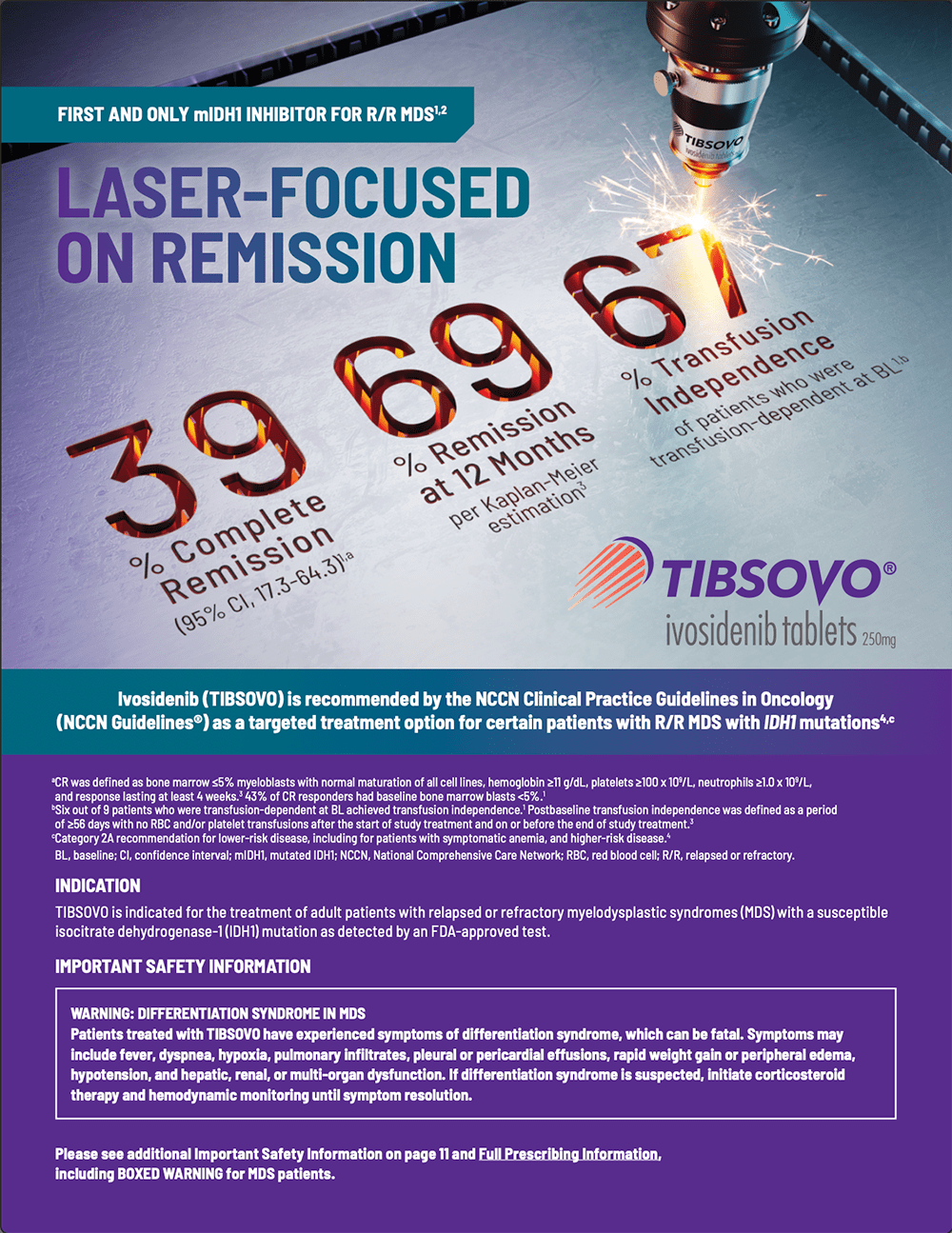
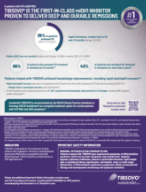
TIBSOVO is approved to treat adult patients with relapsed or refractory mIDH1 myelodysplastic syndromes (MDS). TIBSOVO can be used to treat lower-risk and higher-risk MDS. TIBSOVO is an MDS cancer treatment that targets the mutant IDH1 protein and reduces 2-HG levels by >95%, which induces myeloid differentiation. Thirty-nine percent of patients achieved complete remission with TIBSOVO in the clinical trial (95% CI, 17.3-64.3).1
What are the recommendations for the use of ivosidenib (TIBSOVO) for MDS?
NCCN Clinical Practice Guidelines in Oncology (NCCN Guidelines®) recommend ivosidenib (TIBSOVO) as a
targeted treatment option for certain patients with MDS with IDH1 mutations.a Genetic testing for somatic mutations (ie, acquired mutations) in genes associated with MDS is recommended. NCCN Guidelines® recommend ivosidenib (TIBSOVO) as an NCCN Category 2A treatment option for certain patients with R/R MDS with IDH1 mutations for the management of lower-risk MDS with symptomatic anemia and higher-risk MDS, and as a Category 2A option for certain patients with lower-risk MDS with clinically relevant thrombocytopenia or neutropenia.2
aCategory 2A recommendation for lower-risk disease with symptomatic anemia, or with clinically relevant thrombocytopenia or neutropenia when used in the third line after immunosuppressive therapy (+/- eltrombopag), azacitidine, or decitabine, and for higher-risk disease in transplant patients when used as a single agent following no response to initial treatment, or in non-transplant patients when used following no response, intolerance, or relapse to initial treatment. Category 2B recommendation for lower-risk disease with clinically relevant thrombocytopenia and neutropenia when used in the second line following disease progression, no response, or relapse.2
NCCN, National Comprehensive Cancer Network® (NCCN®)
TIBSOVO efficacy in R/R MDS patients
What trial was TIBSOVO (ivosidenib tablets) studied in for patients with MDS?
TIBSOVO was evaluated in an open-label, single-arm, multicenter study (Study AG120-C-001, NCT02074839) of adult patients with relapsed or refractory MDS with an IDH1 mutation.1 Efficacy was evaluated in 18 patients and safety was evaluated in 19 patients.1 The primary endpoint was CR+PR.3 All observed responses were CRs, with 39% of patients achieving CR with TIBSOVO (95% CI, 17.3-64.3).1
What were the rates of remission with TIBSOVO (ivosidenib tablets)?
Thirty-nine percent of patients achieved CR with TIBSOVO (95% CI, 17.3-64.3). Median duration of CR was not reached, ranging between 1.9 and 80.8+ months (95% CI, 1.9-NE). Median time to CR was rapid at 1.9 months (range, 1.0-5.6 months). Sixty-nine percent of patients who achieved CR were estimated to remain in remission in 6 years.1
Did patients treated with TIBSOVO (ivosidenib tablets) experience improvements in transfusion independence?
The majority of patients achieved or maintained transfusion independence with TIBSOVO. 67% of transfusion-dependent patients (6/9) achieved transfusion independence with TIBSOVO, and 78% of transfusion-independent patients (7/9) remained transfusion independent with TIBSOVO.1
What hematologic improvements did patients experience with TIBSOVO (ivosidenib tablets)?
Patients treated with TIBSOVO achieved hematologic improvements in neutrophil, red blood cell, and
platelet counts.3 44% of patients treated with TIBSOVO achieved marrow CR (mCR), and of the patients
experiencing mCR, 50.0% experienced HI in ≥1 lineage (erythrocyte, platelet and/or neutrophil).3 Rapid and
sustained neutrophil recovery was seen in patients, regardless of treatment response status.3,4 Among
patients who didn't achieve CR, more than half (4/7) experienced rapid neutrophil recovery in a median
time of 0.97 months.4
TIBSOVO safety in MDS
What are the most common side effects associated with TIBSOVO (ivosidenib tablets)?
TIBSOVO is nonmyelosuppressive, with a well-characterized safety profile. The most common (≥25%)
adverse reactions, including laboratory abnormalities, were creatinine increased, hemoglobin decreased,
arthralgia, albumin decreased, aspartate aminotransferase increased, fatigue, diarrhea, cough, sodium
decreased, mucositis, decreased appetite, myalgia, phosphate decreased, pruritus, and rash.1
What are the serious side effects associated with TIBSOVO (ivosidenib tablets)?
Serious adverse reactions in ≥5% of patients included differentiation syndrome (11%), fatigue (5%), and
rash (5%). TIBSOVO can cause differentiation syndrome, QTc interval prolongation, and Guillain-Barré
syndrome. Proper guidance as outlined in Warnings and Precautions should be followed if patients develop signs or symptoms of a serious adverse reaction.1
How are serious side effects of TIBSOVO (ivosidenib tablets) managed?
Patients treated with TIBSOVO can develop differentiation syndrome. If differentiation syndrome is suspected, initiate dexamethasone 10 mg IV every 12 hours (or an equivalent dose of an alternative oral or IV corticosteroid) and hemodynamic monitoring until improvement. If concomitant noninfectious leukocytosis is observed, initiate treatment with hydroxyurea or leukapheresis, as clinically indicated.
Patients treated with TIBSOVO can develop QT (QTc) prolongation and ventricular arrhythmias. Concomitant use of TIBSOVO with drugs known to prolong the QTc interval and CYP3A4 inhibitors may increase the risk of QTc interval prolongation. Interrupt TIBSOVO if QTc increases to greater than 480 msec and less than 500 msec. Interrupt and reduce TIBSOVO if QTc increases to greater than 500 msec. Permanently discontinue TIBSOVO in patients who develop QTc interval prolongation with signs or symptoms of life-threatening arrhythmia.
Guillain-Barré syndrome can develop in patients treated with TIBSOVO. Permanently discontinue TIBSOVO in patients who are diagnosed with Guillain-Barré syndrome.1
Were there any dose modifications reported during the clinical trial?
Permanent discontinuation of TIBSOVO due to an adverse reaction occurred in 5% of patients. The
adverse reaction that resulted in permanent discontinuation of TIBSOVO was fatigue. Adverse reactions
leading to dose interruption of TIBSOVO occurred in 16% of patients. Adverse reactions that required dose
interruption in ≥5% were differentiation syndrome, leukocytosis, and rash. Dose reductions of TIBSOVO
due to an adverse reaction occurred in 16% of patients. Adverse reactions that required a dose reduction
in ≥5% included differentiation syndrome, fatigue, and rash.1
Dosing information with TIBSOVO
What is the TIBSOVO (ivosidenib tablets) recommended dose?
TIBSOVO is a once-daily oral medication that can be taken with or without food. The recommended
dosage of TIBSOVO is 500 mg taken orally once daily until disease progression or unacceptable toxicity.
TIBSOVO is available as a 250-mg film-coated tablet, 2 of which should be taken by patients who are
prescribed TIBSOVO.1
What is the TIBSOVO (ivosidenib tablets) dosing guidance?
TIBSOVO can be taken with or without food, but should not be administered with a high-fat meal. TIBSOVO
tablets should not be split, crushed, or chewed. TIBSOVO should be administered orally about the same
time each day. If a dose of TIBSOVO is vomited, a replacement dose should not be administered; patients
should wait until the next scheduled dose is due.1
What is the guidance for missed doses with TIBSOVO (ivosidenib tablets)?
If a dose of TIBSOVO is missed or not taken at the usual time, patients should administer the dose as soon
as possible and at least 12 hours prior to the next scheduled dose. Patients may return to the normal
schedule the following day. Advise patients to not administer 2 doses within 12 hours.1
What are the recommendations for patients starting TIBSOVO (ivosidenib tablets) prior to treatment initiation?
Prior to initiating treatment with TIBSOVO, obtain an ECG. Monitor ECGs at least once weekly for the first 3 weeks of therapy and then at least once monthly for the duration of therapy. Manage any abnormalities promptly. Assess blood counts and blood chemistries prior to the initiation of TIBSOVO, at least once weekly for the first month, once every other week for the second month, and once monthly for the duration of therapy. Monitor blood creatine phosphokinase weekly for the first month of therapy.1
Testing for and targeting IDH1 mutations
What is the prevalence of IDH1 mutations in MDS?
Up to 4% of patients harbor IDH1 mutations.5 IDH1 mutations are recurring abnormalities associated with
poor prognosis in MDS and can arise anytime during the course of MDS.5 Retest your patients for IDH1
mutations at the first suspicion of clinical change to determine if TIBSOVO may be right for them.6
How often should I test or retest my patients for IDH1 mutations?
Patients with MDS should be retested after disease progression or relapse.6 Initial molecular testing should
always be performed at diagnosis, but the molecular profile of patients with MDS can change over time.2,6
The number of genetic mutations affects risk stratification of patients with MDS, as a higher number of
DNA alterations is associated with worse outcomes.6 Consider TIBSOVO for patients with mIDH1 MDS
experiencing their first relapse.1
How does TIBSOVO (ivosidenib tablets) work to treat MDS?
TIBSOVO is the first-in-class differentiation therapy for mIDH1 MDS.7 TIBSOVO targets the mutant IDH1
protein and reduces 2-HG levels by >95%, which induces myeloid differentiation.1 It may require a
minimum of 6 months of treatment to see a clinical response.1
Evolving classifications in MDS/AML
How are the MDS/AML and MDS-IB2 classifications defined?
MDS/AML, a 2022 ICC classification, is defined as a cytopenic myeloid neoplasm with 10% to 19% blasts in
the blood or bone marrow in the absence of AML-defining recurrent genetic mutations.8 MDS-IB2, a 2022
WHO classification, is defined as 10% to 19% blasts in the bone marrow in the absence of AML-defining
genetic abnormalities.9
What is the incidence of MDS/AML?
Patients classified as MDS/AML may have poorer overall survival outcomes and a greater possibility of progressing to AML.10
How are the AML with defining genetic abnormalities and AML with recurrent genetic abnormalities classifications defined?
According to the 2022 WHO, AML can be diagnosed in the presence of certain mutations and/or defined
genetic abnormalities, irrespective of blast count.9 This classification is referred to as AML with defining
genetic abnormalities.9 Per the 2022 ICC, all entities defined by the presence of certain recurrent genetic
abnormalities and other genetically related entities can be diagnosed as AML if ≥10% blasts are present.8
This classification is referred to as AML with recurrent genetic abnormalities.8
Access and resources with TIBSOVO
What TIBSOVO (ivosidenib tablets) resources are available for healthcare professionals?
The MDS Clinical Overview Brochure, the
Dosing Guide, and the
Prescribing Information are available as downloadable resources for you and your practice.
What TIBSOVO (ivosidenib tablets) resources are available to my patients?
The TIBSOVO Patient Brochure, the
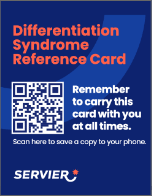
Differentiation Syndrome Reference Card, and the
Medication Guide are available as downloadable resources for your patients. These resources may be useful to patients and caregivers throughout treatment with TIBSOVO.
Does Servier have a TIBSOVO (ivosidenib tablets) patient services program?
ServierONE® is the Servier Patient Services program. ServierONE Patient Support Services for TIBSOVO offers support with insurance coverage and reimbursement, financial assistance to help patients pay for TIBSOVO, and prescription fulfillment through our network of specialty pharmacies and distributors. For more information visit
ServierOne.com
or call 1-800-813-5905.
How is TIBSOVO (ivosidenib tablets) ordered and distributed?
TIBSOVO is only available through our specialty distributors and network specialty pharmacies. TIBSOVO is available through specialty distributors for shipment directly to office- or hospital-based pharmacies and can also ship directly from the specialty pharmacy to your patient’s home or preferred location.
How can healthcare professionals request a visit with a TIBSOVO (ivosidenib tablets) representative?
A request-a-visit form is available on our website to schedule a visit with a TIBSOVO representative. After you have submitted this registration form, a TIBSOVO sales representative will contact you to schedule your appointment.