Copay

ServierONE connects your eligible patients to the right support programs and services that may help them pay for their TIBSOVO treatment.

The TIBSOVO Copay Program can help lower out-of-pocket costs
for commercially insured patients

Enroll your patients

Eligible commercially insured patients may pay as little as $0 per prescription
for TIBSOVO through the Copay Program.

Who is eligible?*

  • Patients who reside in the U.S., U.S. territories, or Puerto Rico
  • Patients who are commercially or privately insured and paying a portion of the cost

*Not valid for patients whose prescription claims are reimbursed in whole or in part by any state or federal government program, including Medicaid, Medicare, Veterans Affairs (VA), Department of Defense (DOD), and TRICARE.

ServierONE Logo.

Patient support services

ServierONE® connects your eligible patients to the right support programs and services that may help them pay for their TIBSOVO treatment.

Support For Your Patient Every Step of the Way

We offer:

  • Support with insurance coverage and reimbursement
  • Financial assistance to help patients pay for TIBSOVO
  • Tools and resources to navigate insurance
  • Access to a one-on-one Patient Experience Manager

To receive more information

OR
CALL 1-800-813-5905 Monday‐Friday, 8 AM to 8 PM ET to contact a
Patient Services representative directly.

Register online for the Commercial Copay Program at ServierONE-copay.com.

Ordering and distribution network

National Drug Code (NDC)

NDCs 10-digit code: 72694-617-60
11-digit code: 72694-0617-60
Dosage strength 250 mg/tablet
Description 250-mg tablet: Blue oval-shaped film-coated tablet debossed “IVO” on one side and “250” on the other side

The red zero converts the 10-digit NDC to the 11-digit NDC. Some payers may require each NDC to be listed on the claim. Payer requirements regarding the use of NDCs may vary. Electronic data exchange generally requires use of the 11-digit NDC.
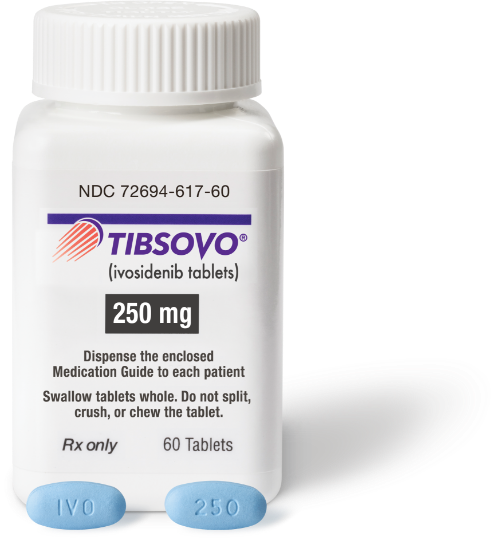

TIBSOVO® (ivosidenib tablets) bottle with two pills.

Tablet not to scale

Product information

How TIBSOVO is supplied: 250-mg tablets, supplied in 60-count bottles (30-day supply) with a desiccant canister

Storage: Store at 20 to 25 ºC (68 to 77 ºF)


Distribution network for TIBSOVO

TIBSOVO is only available through our specialty distributors and network specialty pharmacies.

Specialty distributors

TIBSOVO is available through specialty distributors for shipment directly to office- or hospital-based pharmacies.

Network specialty pharmacies

TIBSOVO ships directly from the specialty pharmacy to your patient’s home or preferred location.

Network specialty pharmacies with direct-to-home delivery


Indication

TIBSOVO is indicated for the treatment of adult patients with relapsed or refractory myelodysplastic syndromes (MDS) with a susceptible isocitrate dehydrogenase-1 (IDH1) mutation as detected by an FDA-approved test.

IMPORTANT SAFETY INFORMATION

WARNING: DIFFERENTIATION SYNDROME IN MDS
Patients treated with TIBSOVO have experienced symptoms of differentiation syndrome, which can be fatal. Symptoms may include fever, dyspnea, hypoxia, pulmonary infiltrates, pleural or pericardial effusions, rapid weight gain or peripheral edema, hypotension, and hepatic, renal, or multi-organ dysfunction. If differentiation syndrome is suspected, initiate corticosteroid therapy and hemodynamic monitoring until symptom resolution.

WARNINGS AND PRECAUTIONS

Differentiation Syndrome in MDS: Differentiation syndrome is associated with rapid proliferation and differentiation of myeloid cells and may be life-threatening or fatal. Symptoms of differentiation syndrome in patients treated with TIBSOVO included noninfectious leukocytosis, peripheral edema, pyrexia, dyspnea, pleural effusion, hypotension, hypoxia, pulmonary edema, pneumonitis, pericardial effusion, rash, fluid overload, tumor lysis syndrome, and creatinine increased.

If differentiation syndrome is suspected, initiate dexamethasone 10 mg IV every 12 hours (or an equivalent dose of an alternative oral or IV corticosteroid) and hemodynamic monitoring until improvement. If concomitant noninfectious leukocytosis is observed, initiate treatment with hydroxyurea or leukapheresis, as clinically indicated. Taper corticosteroids and hydroxyurea after resolution of symptoms and administer corticosteroids for a minimum of 3 days. Symptoms of differentiation syndrome may recur with premature discontinuation of corticosteroid and/or hydroxyurea treatment. If severe signs and/or symptoms persist for more than 48 hours after initiation of corticosteroids, interrupt TIBSOVO until signs and symptoms are no longer severe.

QTc Interval Prolongation: Patients treated with TIBSOVO can develop QT (QTc) prolongation and ventricular arrhythmias. Concomitant use of TIBSOVO with drugs known to prolong the QTc interval (e.g., anti-arrhythmic medicines, fluoroquinolones, triazole anti-fungals, 5-HT3 receptor antagonists) and CYP3A4 inhibitors may increase the risk of QTc interval prolongation. Conduct monitoring of electrocardiograms (ECGs) and electrolytes. In patients with congenital long QTc syndrome, congestive heart failure, electrolyte abnormalities, or those who are taking medications known to prolong the QTc interval, more frequent monitoring may be necessary.

Interrupt TIBSOVO if QTc increases to greater than 480 msec and less than 500 msec. Interrupt and reduce TIBSOVO if QTc increases to greater than 500 msec. Permanently discontinue TIBSOVO in patients who develop QTc interval prolongation with signs or symptoms of life-threatening arrhythmia.

Guillain-Barré Syndrome: Guillain-Barré syndrome can develop in patients treated with TIBSOVO. Monitor patients taking TIBSOVO for onset of new signs or symptoms of motor and/or sensory neuropathy such as unilateral or bilateral weakness, sensory alterations, paresthesias, or difficulty breathing. Permanently discontinue TIBSOVO in patients who are diagnosed with Guillain-Barré syndrome.

ADVERSE REACTIONS

The most common adverse reactions including laboratory abnormalities (≥25%) in patients with relapsed or refractory MDS are creatinine increased, hemoglobin decreased, arthralgia, albumin decreased, aspartate aminotransferase increased, fatigue, diarrhea, cough, sodium decreased, mucositis, decreased appetite, myalgia, phosphate decreased, pruritus, and rash.

DRUG INTERACTIONS

Strong or Moderate CYP3A4 Inhibitors: Reduce TIBSOVO dose with strong CYP3A4 inhibitors. Monitor patients for increased risk of QTc interval prolongation.

Strong CYP3A4 Inducers: Avoid concomitant use with TIBSOVO.

Sensitive CYP3A4 Substrates: Avoid concomitant use with TIBSOVO.

QTc Prolonging Drugs: Avoid concomitant use with TIBSOVO. If co-administration is unavoidable, monitor patients for increased risk of QTc interval prolongation.

LACTATION

Advise women not to breastfeed.

Please see Full Prescribing Information, including BOXED WARNING for MDS patients.

Last update: August 2026


Information on this website is reviewed through established medical, legal, and regulatory processes to support accurate, balanced, and label-consistent communication about TIBSOVO.


INDICATION

TIBSOVO is indicated for the treatment of adult patients with relapsed or refractory myelodysplastic syndromes (MDS) with a susceptible isocitrate dehydrogenase-1 (IDH1) mutation as detected by an FDA-approved test.

Indication & Important Safety Information

IMPORTANT SAFETY INFORMATION

WARNING: DIFFERENTIATION SYNDROME IN MDS

Patients treated with TIBSOVO have experienced symptoms of differentiation syndrome, which can be fatal. Symptoms may include fever, dyspnea, hypoxia, pulmonary infiltrates, pleural or pericardial effusions, rapid weight gain or peripheral edema, hypotension, and hepatic, renal, or multi-organ dysfunction. If differentiation syndrome is suspected, initiate corticosteroid therapy and hemodynamic monitoring until symptom resolution.