
Real-world assessment of TIBSOVO + AZA in newly diagnosed AML
TIBSOVO + AZA was compared to venetoclax (VEN) + HMA in a retrospective U.S. chart review of patients with newly diagnosed, IC-ineligible mIDH1 AML1,a
Study limitations
- Utilization of real-world evidence to compare treatment regimens may be misleading because of potential bias in the healthcare professional and/or patient selection of therapies and low internal validity.
- Only 22.8% of patients treated with VEN + HMA received the full FDA-approved 28 days of VEN during the 28-day cycles and 44.6% did not receive >11 days of VEN per cycle.2 This may have impacted the outcomes observed in the VEN + HMA cohort.
- Because of the limitations of this analysis, comparisons between regimens should not be made.
Efficacy
Observed rates of CR and CR + CRi/p for TIBSOVO + AZA vs VEN + HMA1,c
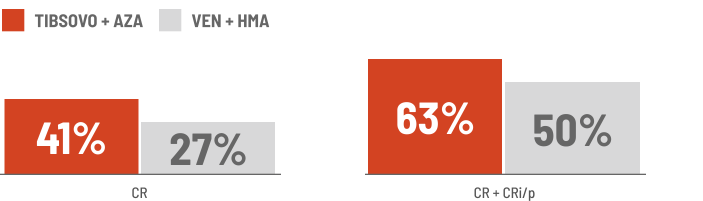
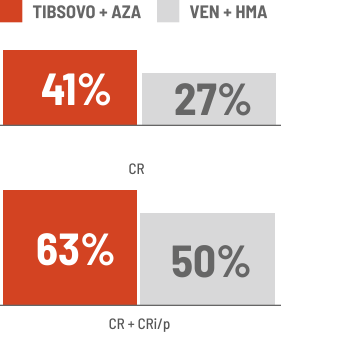
- Median time to best response was 3.2 months with TIBSOVO + AZA vs 4.1 months with VEN + HMA1
- Median time to first BM biopsy was 50 days with TIBSOVO + AZA and 61 days with VEN + HMA; therefore, any earlier responses that may have occurred would not have been recorded
The efficacy of TIBSOVO + AZA observed in this real-world assessment was consistent with the efficacy demonstrated in the AGILE study1,3,4
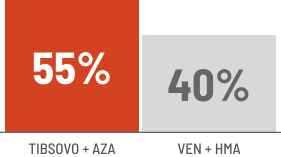
Observed 6-month EFS rate for TIBSOVO + AZA vs VEN + HMA1,c
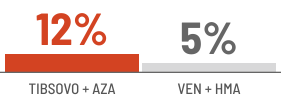
Rate of patients proceeding to allogeneic stem cell transplant for TIBSOVO + AZA vs VEN + HMA1
Safety
Safety observations with TIBSOVO + AZA vs VEN + HMA1
- The most common Grade 3+ adverse events were thrombocytopenia (13% with TIBSOVO + AZA vs 10% with VEN + HMA), febrile neutropenia (13% with TIBSOVO + AZA vs 13% with VEN + HMA), neutropenia (13% with TIBSOVO + AZA vs 10% with VEN + HMA), and infection (8% with TIBSOVO + AZA vs 11% with VEN + HMA)
- Unscheduled acute care within the first 12 weeks was needed for 40% of patients treated with TIBSOVO + AZA vs 70% of patients treated with VEN + HMA
- Differentiation syndrome was observed in 2 patients (1.4%) treated with TIBSOVO + AZA
- Treatment discontinuation was 37% for the TIBSOVO + AZA regimen and 38% for the VEN + HMA regimen
A short delay from diagnosis to treatment to obtain molecular test results does not affect patient outcomes.5 Test your patients at diagnosis to consider TIBSOVO + AZA as the front-line treatment of choice for patients with newly diagnosed, IC-ineligible mIDH1 AML6
a This retrospective subgroup analysis compares TIBSOVO + AZA (n=143) vs VEN + HMA (n=101). The TIBSOVO + AZA cohort is a subset of a larger patient population (n=182) that was previously presented. Treatment was delivered in both community and academic settings from November 2021 through November 2022 with a minimum follow-up of 6 months. Collected data included baseline patient and practice characteristics, mutational testing, treatment patterns and rationale, and efficacy and safety outcomes. Endpoints focused on events likely to occur within 6 months of follow-up, including response rates, tolerability, bridge to transplant, and acute care episodes.1,2
b ELN cytogenetic risk status was favorable for 25% vs 13%, intermediate for 56% vs 65%, poor for 16% vs 14%, and not assessed for 3% vs 8% of patients treated with TIBSOVO + AZA vs VEN + HMA, respectively. For the TIBSOVO + AZA and VEN + HMA cohorts, median age was 61 and 65 years, respectively, and 69% and 61% were male, respectively. Prior myelodysplastic syndromes, myeloproliferative neoplasms, sAML, or sAML-like mutations occurred in 39% of patients treated with TIBSOVO + AZA vs 34% of patients treated with VEN + HMA.1
c EFS is defined as CR within 24 weeks, and no relapse or death.
AML, acute myeloid leukemia; AZA, azacitidine; BM, bone marrow; CR, complete response; CRi/p, CR with incomplete count recovery or incomplete platelet recovery; EFS, event-free survival; ELN, European LeukemiaNet; HMA, hypomethylating agent; IC, induction chemotherapy; IDH1, isocitrate dehydrogenase‑1; mIDH1, mutated IDH1; sAML, secondary AML; VEN, venetoclax.